
There are few skin concerns as frustrating as the sudden appearance of crepey skin. One day, your skin feels smooth and resilient; the next, it seems to have a paper-thin, finely wrinkled texture, especially on the face, neck, or arms. If you’ve been asking yourself, “what causes crepey skin?” you’re not alone. It’s a common concern that sends many searching for answers, often leading to a cabinet full of creams that promise much but deliver little. But what if the answer wasn’t on the surface, but deep within your cells?
First, What Exactly Is Crepey Skin?
Unlike deeper, expression-related wrinkles, crepey skin is characterized by its thin, fragile, and finely wrinkled surface, much like crepe paper. It often covers a larger area and is most noticeable where the skin is already thin, such as under the eyes, on the neck, and on the inner arms. While it’s a natural part of the aging process, certain factors can accelerate its development, making the skin appear older than it is.
For years, the primary culprits were thought to be sun exposure and simple dehydration. While UV radiation from the sun is undeniably a major factor in breaking down collagen and elastin—the proteins that give skin its structure and bounce—it isn’t the whole story. Many people with diligent sun care routines still develop this frustrating skin texture, which points to a deeper, internal process at play.
Beyond Sun Damage: The Hidden Culprit in Your Cells
Recent dermatological research has uncovered a more fundamental cause of skin aging, including the formation of crepey skin. The issue begins at a microscopic level with a phenomenon known as cellular senescence. It’s a complex-sounding term for a simple, yet destructive, process.
Introducing “Zombie Cells” (Cellular Senescence)
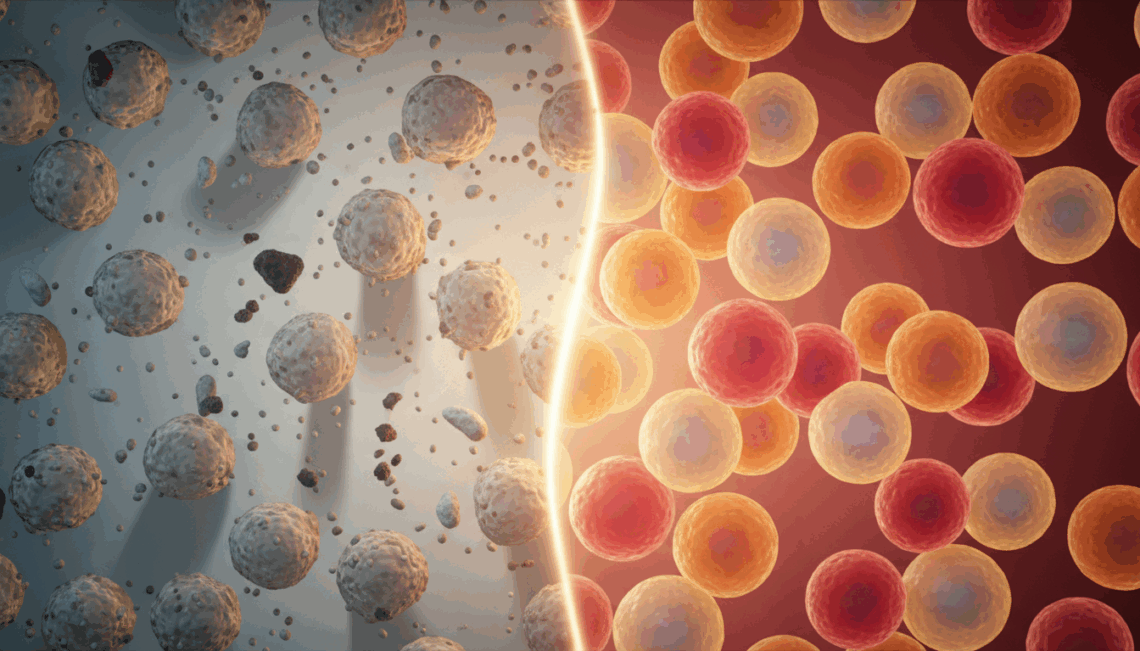
As we age, or due to stress and environmental damage, our skin cells can enter a state called senescence. In this state, they stop dividing and functioning properly. Instead of being cleared away by the body’s natural processes, they linger like “zombie cells.” These zombie cells aren’t just inactive; they actively secrete inflammatory substances that damage the healthy, youthful cells around them. This creates a toxic environment within your skin’s layers, accelerating the aging process from the inside out.
How These Cells Affect Your Skin’s Appearance
This cascade of cellular damage has a direct impact on your skin’s structure. The inflammatory signals sent by zombie cells degrade collagen and elastin far more efficiently than external factors alone. The result? The supportive matrix of your skin weakens, leading to a loss of firmness, elasticity, and thickness. This internal collapse is what manifests on the surface as thin, fragile, and crepey skin. You’re not just seeing surface-level aging; you’re seeing the result of a cellular battle that your skin is losing.

Why Aren’t My Other Skincare Products Working?
This brings us back to the frustrating experience of trying countless products with little success. Most conventional moisturizers, serums, and creams work on the surface. They might temporarily hydrate the skin, making it appear plumper for a few hours, but they don’t address the root cause—the accumulating damage from senescent cells. It’s like painting over a crack in a wall without fixing the foundation. The problem will always resurface because the underlying structure is still compromised.
To truly combat crepey skin, you need a solution that goes beyond superficial hydration and targets the source of the degradation. You need an approach that helps address the “zombie cell” problem and supports the skin’s natural ability to rebuild its youthful matrix.
A Scientific Breakthrough in Restoring Skin’s Youthful Matrix
Fortunately, scientific understanding of this process has paved the way for a new generation of skincare. The focus has shifted from merely moisturizing to actively intervening in the cellular aging process. Researchers have identified specific biological pathways that can be targeted to help mitigate the damage caused by these lingering zombie cells.
Targeting the Source: A New Approach
One of the most exciting discoveries involves understanding how these zombie cells cause so much collateral damage. A key protein, when activated in these cells, essentially causes them to “explode,” spreading their inflammatory contents to neighboring healthy cells and accelerating the aging cycle. By finding a way to neutralize this process, it becomes possible to protect healthy skin cells and give them a chance to function properly again.
A Polynesian Ritual Meets Modern Science: The Mitolyn Approach
This is where ancient wisdom and modern science converge. Inspired by a Polynesian ritual known for preserving youthful skin, a product called Mitolyn was developed. It leverages a powerful, natural ingredient—Kukui Nut Oil, sourced directly from Hawaii—which has been found to be rich in compounds that help protect the skin from this specific type of cellular self-destruction.
Mitolyn’s formula is designed to be a “cellular defender.” It works by helping to neutralize the destructive protein cascade before it can damage surrounding tissue. This approach doesn’t just mask the problem; it addresses the underlying mechanics of what causes crepey skin. By protecting healthy cells from the inflammatory fallout of zombie cells, it helps restore the environment your skin needs to produce healthy collagen and elastin again. This leads to a visible improvement in firmness, a reduction in the paper-thin texture, and a restoration of that youthful bounce.
How to Incorporate This Advanced Approach into Your Routine
Integrating a solution like Mitolyn is simple. It functions as a targeted serum, applied to clean skin before your regular moisturizer. This allows its potent ingredients to penetrate deeply and work at the cellular level where the problem begins.
1. Cleanse Thoroughly: Start with a gentle cleanser to remove impurities and prepare your skin.
2. Apply the Targeted Serum: Dispense a small amount of the serum and gently massage it into the areas of concern, such as the face, neck, and chest.
3. Moisturize and Protect: Follow up with your favorite moisturizer to lock in the serum and hydrate the skin’s surface. During the day, always finish with a broad-spectrum sunscreen to prevent further damage.
By shifting your focus from temporary fixes to addressing the cellular root of aging, you can finally move beyond the frustration of crepey skin. It’s about working smarter, not harder, by giving your skin the targeted support it needs to defend and rebuild itself from within.
Frequently Asked Questions About Cellular Skin Aging
Can lifestyle changes help with “zombie cells”?
Yes, to an extent. A healthy lifestyle with a balanced diet rich in antioxidants, regular exercise, adequate sleep, and stress management can help reduce the overall burden of cellular stress that leads to senescence. However, as it is also a natural part of aging, targeted skincare can provide crucial, direct support to the skin.
How long does it take to see results from a cellular-based approach?
Because these solutions work on a deeper level, results are not instantaneous but are more profound and long-lasting. Skin cell turnover takes time. Most users begin to notice improvements in skin texture, firmness, and hydration within a few weeks of consistent daily use, with more significant results appearing over one to three months.
Is this approach suitable for sensitive skin?
Many advanced serums are formulated to be gentle. Ingredients like Kukui Nut Oil are known for their soothing properties. However, as with any new product, it is always recommended to perform a patch test on a small area of skin before applying it to your entire face, especially if you have a history of sensitivity. Consulting with a dermatologist is always the best course of action for personalized advice.